Our Pale Blue Dot Has Grown in Its Arrogance, Ignorance and Greed
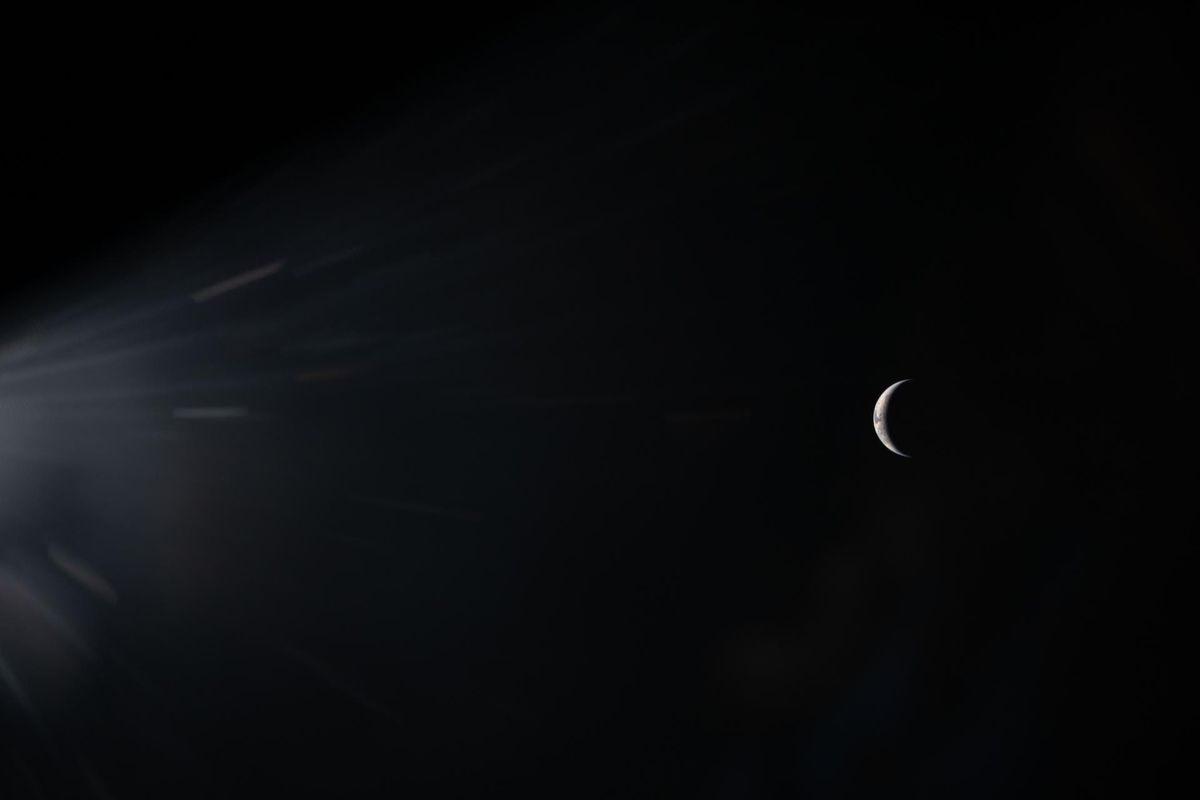
A composite animation produced by Seán Doran from Artemis II mission images reveals the conditions that make the Kessler Syndrome our worst nightmare. The Kessler Syndrome is a ring of high‑speed metal encircling God’s green Earth — a crown of iron in a game of thrones that could end mankind.

The Kessler Syndrome, proposed by NASA scientist Donald J. Kessler in 1978, describes a tipping point in low Earth orbit where the density of objects becomes so high that one collision triggers a chain reaction of many more.
Instead of disappearing, two colliding satellites or rocket bodies explode into thousands of high‑velocity fragments. Each fragment becomes a new projectile capable of striking another object, creating still more debris. Over time, this runaway cascade can form a permanent, impenetrable shell of junk around the planet — a self‑sustaining “domino effect” in space.
In early May 2026, Gizmodo published a small article about a composite animation created from Artemis II mission images. The animation was assembled by visual artist Seán Doran, a digital image processor who works primarily with real space‑agency imagery.
The series of images strung together and published on Bluesky show Earth hanging in a cocoon of bright points, dozens of them scattered across the darkness and blanketing the space around our planet.
These are not stars. They are intact payloads — active satellites and dead ones — along with discarded upper‑stage rocket bodies, mission‑related debris, and fragmentation shrapnel created when any of these objects break apart.
We have allowed a very small group of ignorant and greedy men to begin building, at an alarming rate, a ring around our world — a ring of discarded fuel tanks, short‑sighted technologies, death machines no longer under human control, and a high‑probability path toward the end of mankind if this continues.
Mankind is currently contributing more debris than natural removal can clear.
At the moment regulation is required, federal regulators have backed away from stricter orbital‑debris rules, despite years of warnings from NASA, ESA, and independent astrophysics organizations and scientists.
NASA’s Orbital Debris Program Office (ODPO) is the U.S. government’s lead scientific body for tracking, modeling, and characterizing this environment. Through its Orbital Debris Quarterly News and associated technical datasets, ODPO publishes the authoritative accounting of how many objects are in Earth orbit and how much total mass they represent, broken down into spacecraft, rocket bodies, mission‑related debris, and fragmentation debris. This dataset is the backbone of every long‑term debris‑evolution model used internationally.
According to the most recent NASA and ESA estimates, more than 13,500 metric tons of human‑made material now orbit Earth. The majority of this mass—roughly 70–72%—is concentrated in intact payloads, including active satellites and large “dead” spacecraft. Rocket bodies account for another 20–25%, while the remaining mass is distributed among mission‑related debris and the millions of fragments produced by past collisions and explosions.
This distribution matters. When reports state that payloads make up 71% of the total mass in orbit, it means that the vast majority of the 13,500+ metric tonnes of material overhead is not small “trash” (like paint chips or bolts), but massive, intact machines. These objects are the dominant mass reservoir in Earth orbit. They are the “future debris” waiting to happen.
China, Russia, and the United States are the top producers of space debris in this order, driven by three catastrophic fragmentation events: China’s 2007 ASAT test, Russia’s 2021 ASAT test, and the 2009 Iridium–Cosmos collision. Together, these incidents generated thousands of trackable fragments and tens of thousands of smaller, untracked pieces.
SpaceX, meanwhile, is the undisputed leader in satellite production volume due to its Starlink megaconstellation. It mass‑produces satellites at a rate unparalleled by any other organization.
Starlink is estimated to maintain over 10,200 active satellites in orbit as of May 2026. Based on approximate mass per unit (mixed), Starlink could be responsbile for approximately ~5,810 – 6,360 metric tonnes of material.
While Starlink is not a major debris creator, its sheer scale accelerates orbital crowding and increases collision probability across every shell of low Earth orbit.
ESA’s Space Environment Report 2025 confirms the trend: the tracked and estimated populations exceed 13,500 metric tonnes, with payloads making up roughly 71% of this mass. The orbital environment is not dominated by fragments. It is dominated by large, intact objects that will become fragments when the next collision occurs.
Why This Is Alarming
1. Intact Objects Are “Debris Factories”
Most of the mass in orbit is not small junk — it’s big, intact machines. When a large object breaks up, it produces orders of magnitude more debris. A 1‑ton satellite hit by a bolt produces fragments. A 5‑ton satellite hit by a bolt produces thousands. These intact objects have been referred to as “debris factories.” They are not dangerous because they exist. They are dangerous because if they fail, they fail catastrophically.
This is the primary driver of the Kessler Syndrome: the bulk of the “future” debris is currently stored inside these large masses. The orbital environment is pre‑loaded with risk.
2. High Kinetic Energy
Because these payloads are so heavy and moving at roughly 17,500 mph, they possess enormous kinetic energy. A collision involving a payload isn’t a “fender bender”; it is an explosion that can pollute an entire orbital plane for decades.
3. “Dead” Mass Is Uncontrollable
A significant portion of that 71% consists of zombie satellites—payloads that have run out of fuel or suffered electronics failure. Since they cannot be steered, they are “sitting ducks” for other debris. Operators of active satellites must maneuver constantly to avoid these drifting giants.
4. The “Graveyard Orbit” Problem
In higher orbits (like GEO), there is no atmosphere to drag these payloads down. Once a payload is sent there, that mass stays there effectively forever. We are building a permanent shell of heavy metal around the planet.
5. Launch Intensity
The fact that mass is concentrated in payloads shows how quickly we are adding material to space. With megaconstellations like Starlink and Kuiper, we are adding more “payload mass” in a single decade than we did in the previous five decades combined.
Sources
Gizmodo (May 2026), Composite Artemis II Animation Shows Just How Much Stuff Is in Low Earth Orbit https://gizmodo.com/composite-artemis-ii-animation-shows-just-how-much-stuff-is-in-low-earth-orbit-2000755806
Seán Doran — Composite Animation (Bluesky) https://bsky.app/profile/seandoran.bsky.social
NASA — Orbital Debris Program Office (ODPO) https://orbitaldebris.jsc.nasa.gov
ESA — Space Environment Report 2025 https://www.esa.int/Safety_Security/Space_Debris/ESA_Space_Environment_Report